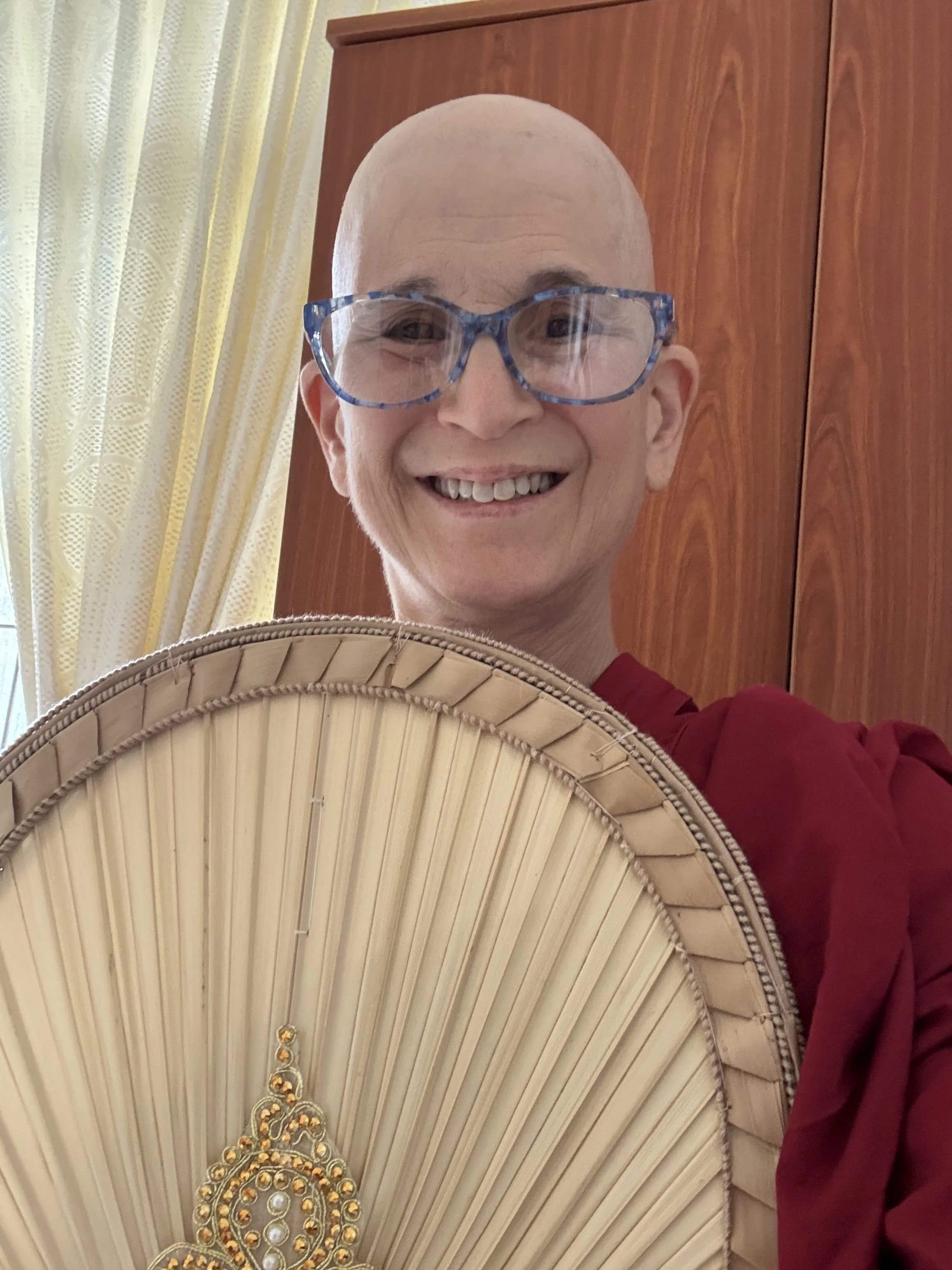
An interview with Jamie Roberts
by Amy Ward Brimmer
Amy: I'm really curious about how this decision came to be. Is this something you wanted to do for many years? How did you come to the conclusion, "I'm going to ordain as a Buddhist nun"? Can you say a little bit about that process?
Jamie: I have been meditating for 30 years, and early in that timeframe, I started going to retreats that were offered by Steve Armstrong and Kamala Masters. Steve often did what he called "bedtime stories," which he told at the last sit of the evening, often about memories of the time he spent as a monk in Myanmar. He'd been a monk for five years, and he had all these beautiful stories. I was so inspired, and his practice seemed so deep, so I thought it would be helpful to be in a situation where I could just practice.
And Kamala Masters also talked about spending a year as a nun. It's a different kind of nun than an ordained one, but I didn't understand that at the time. It was around 2011 when I was first exposed to this idea that you could temporarily ordain, and I . So it's been almost two decades of wishing. I actually prefer the term monastic or monk to the word “nun,” since this is a mistranslation of the word bhikkhuni, which is just a feminized version of the word, bhikkhu or “monk.” But that’s just me being a retired ESL teacher.
AWB: It made sense to plan it for your retirement, a practical move.
JR: Yeah, I would have never been able to afford it prior to that. During my sabbatical in 2023, I was able to sit the three-month retreat at IMS, and that was an amazing gift.
So that gave me a taste. I was already saving up for what I thought would be this big expense of going to. . . . somewhere, I wasn’t sure where yet. I knew I didn't want to go to Myanmar because of the treatment of the Rohingya there, and I learned that going to Thailand wouldn't be very effective for me as a woman. Neither of those places ordain women monastics. I learned a lot about how women are treated vastly differently, not because the Buddha was against ordaining women, but because the people who succeeded the Buddha did not honor his wishes about women monastics. So it did play into where I chose to go, and also what my life was like there, because it was different than I imagined. It was still wonderful, but it wasn't the scenario I imagined.
When we were on the three-month retreat, I talked to Bhante Buddharakkhita and I kept in touch with him, and the idea originally was that I would go to Uganda and ordain at his monastery.
But then I read the U.S. government's warning that no one should go there, because ISIS was still active. And I thought, I don't mind breaking rules, but maybe this is one I shouldn't. I don't want to be one of those people in the news that people read about and go, "why did they even go there?"
AWB: What was she thinking, right?
JR: I was concerned, but I didn't rule it out necessarily, since I had nowhere else to go. Then I spoke to my wonderful Sri Lankan friend Darshani. She said, "Why don't you go to Sri Lanka?" That had actually been my first choice, because Sri Lanka is the country that brought back female ordination after a thousand years of women being barred from ordination in Theravada Buddhism. I just didn't know anyone there. But because Darshani's from there and she knew a lot of people, she did all this research and checked out some monasteries for me, and helped me find the one that I ended up living at for a year.
AWB: That's so kind. How do you know Darshani?
JR: She's a Dhamma sister from one of the groups that I met through Venerable Analyo's course. We’ve been meeting since 2019. So Darshani did quite a bit to help me get to where I ended up.
AWB: And where was that? Tell me about the monastery.
JR: It's called Damrisi Meditation Centre. It's in a suburb of Colombo called Homagama, which is apparently the most Buddhist municipality, population-wise, in Sri Lanka.
AWB: And is this part of the Theravadan or early Buddhist lineage?
JR: They're part of the Early Buddhist lineage and they use the word Theravada. I would say that most Buddhism in Sri Lanka is Theravadan.
The chief bhikkhuni at Damrisi is Venerable Therika. It’s a small monastery, but she is very revered within the monastery’s large lay community. She's young. I think she's either 39 or 40 years old, but she runs this whole community. And not just the monastery, but apparently she also meets with people to offer Dhamma advice, sometimes up till 10:00 at night. She even goes to homes and offers Dhamma talks.
She's amazing. I've never met anyone like Venerable Therika. It is strongly believed by many that she has achieved some level of enlightenment and when I spent time with her, I could definitely understand why this is believed.
AWB: So it’s a small community. How many other nuns?
JR: When I first arrived, Venerable Therika was in Australia for the rains retreat. Then there was a guest bhikkhuni from Korea, and three others.
AWB: Wow, that’s an intimate group.
JR: Yeah, it was very small. There was an older nun, (I say older, but I was actually the oldest). She was 62. And then there was a woman who was 39. And then two very young ones -- and this is really interesting to me. One of them was 22 and the other was 19 and the 19-year-old had been there since she was 15. I asked her, “How long have you wanted to be a monastic?” And she said, “since preschool.” Her parents are very devout Buddhists, so they were excited when she asked Venerable Therika when she could come to live at the monastery, and Venerable Therika said, “you can come today.” A week later she moved in, and she's been there ever since.
The two young ones are roommates, and they have the most incredible relationship. It's beautiful. They treat each other with such respect and care. And it's really interesting because relationships in Sri Lanka in general are somewhat different than here. And within it there's this. . . I don’t know. You've heard it before. Americans and most Westerners are very individualistic. Whereas over there, it's the harmony of the group that's most important.
So it was just a beautiful relationship within the sangha. Basically being a newcomer in a strange place where everyone's lived together for a couple of years (except for the bhikkhuni from Korea), this environment of mutual respect and care made my transition to life at the monastery easier.
That Korean nun was interesting. Sri Lankans are very laid back about certain things. For instance, everything is in order of when you were ordained. So I was the oldest, but I was the baby. Every day I would bow to all the others, including the 19-year-old. I was bowing so much they told me, “You don't have to bow all the time. We really only bow to each other in the morning and in the evening. We know the respect is there.” No one had told me what to do, so I just followed what I saw the others doing.
The nun from Korea was very strict about rank and that sort of thing, which I found curious. I noticed a difference between how the Sri Lankan nuns were about such things -- very chill and casual -- and how she was. She was there until December.
AWB: And you were there for a year, right?
JR: I was there for a year. The first few months, I was an anagarika.
AWB: I’ve heard that word but I’m not sure what it means.
JR: An anagarika is usually a person who lives at the monastery, and they're devoted to helping the monastics and doing things that the monks and nuns can't do, like shopping. But in my case, I was just basically a monastic in training. So I did everything they did. The only thing that was different is I just wore all white and I still had hair at that time.
When Venerable Therika came back, I was ordained in a pretty interesting ceremony that took quite a few hours. It was fantastic.
AWB: So for the first 3 months you were an anagarika and then you received ordination. Aside from a shaved head, what else was different after that?
JR: Once I was ordained there was a big difference in my relationship to the community and in my daily activity. For instance, when I was an anagarika I ate in the lay dana hall, but I was fully moved into the nuns dana hall after I was ordained. That was on October 28th.
AWB: I’d like to hear about a typical day for you. Is there such a thing as a typical day?
JR: There were two kinds of ordinary days, the everyday schedule and the retreat schedule, which took place during the first 14 days of each month.During the everyday schedule,we woke up at 4:00 am, and from 4:30 to 5:30 we meditated. We didn't necessarily meditate together. You could meditate in your room, or you could climb the steps to the third floor and meditate in the meditation hall, or you could go to various other places. But it wasn't as though we all met together and practiced the way we do at IMS.
From 5:30 to 5:45 am was officially gilampasa, which is a tea break, but that word actually means medicine. And believe me, for many Sri Lankans, tea is medicine. And there are norms for this because it is considered meditation - for instance, you drink your tea sitting down and mindfully. This was kind of hard for me because I'm not a tea drinker. I only like one specific Japanese tea. So I either drank water or coffee the times I was there.
Anyway, that was 15 minutes. From 5:45 to 6:15 AM, we set up the chanting room. That seemed like quite a lot at first, although I got used to it. One of us picked all the flowers for the altar. We had to light a lamp, and that usually meant skimming all the flies out of the oil in the lamp. We swept the floor, we refilled a water container, we lit incense.
Once the flowers were picked, we arranged the flowers in various beautiful designs. Then some of the flowers and a stick of incense went to a lower level, where there was a Bodhi tree that Venerable Therika had brought back from India and a Buddha in front of that, and we also made an offering there.
When that was all prepared, we chanted from 6:15 to 6:45-ish, and that included a bunch of chants honoring Buddha, Dhamma and Sangha and we also chanted the Karaniya Metta sutta every morning.
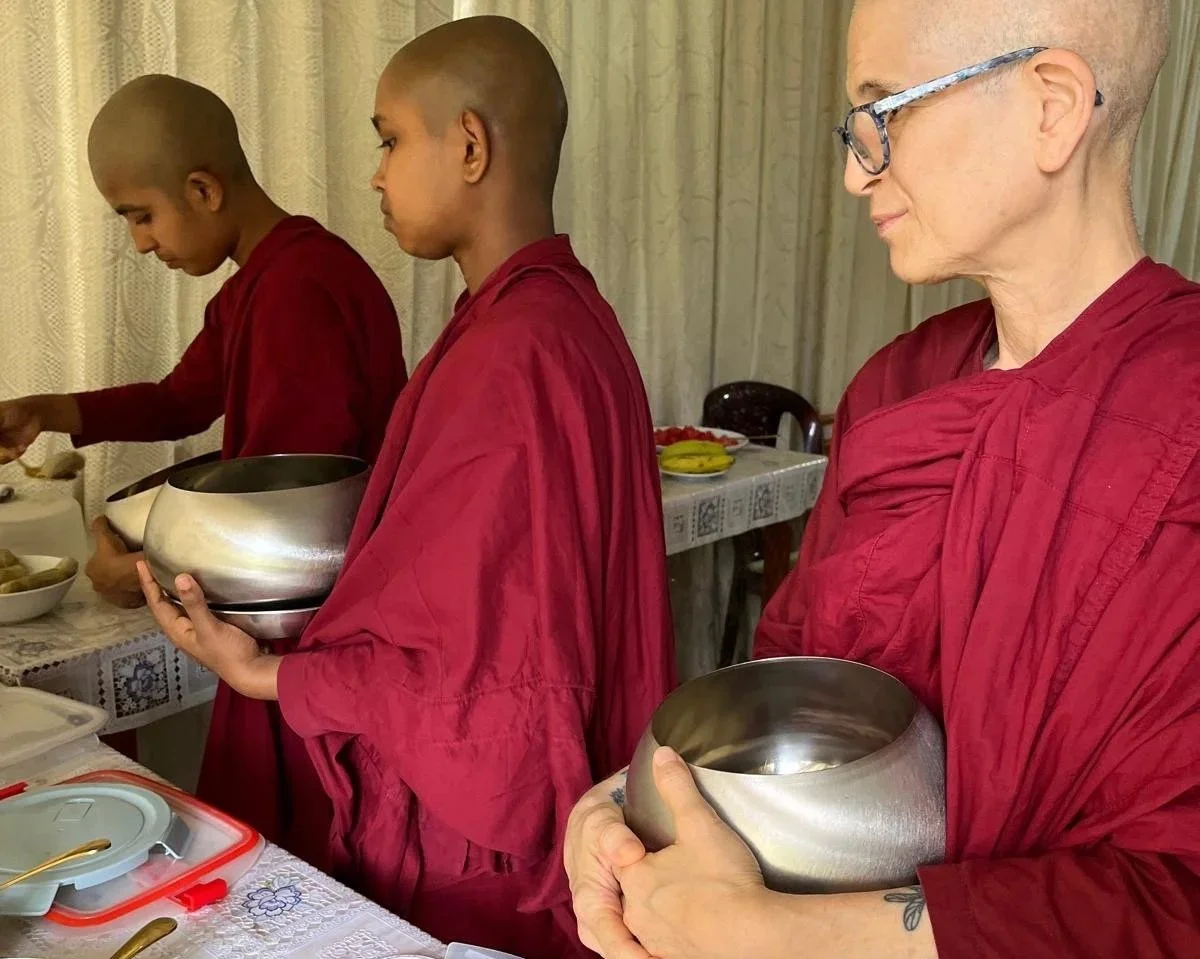
Then we had breakfast. One of us cut the fruit in the kitchen. We lined up in order of when we were ordained and we did a little procession called pindapata (alms round), out the door and across the compound to the dana hall where there was a table with food offerings on it. And the cook or someone that was representing the cook would offer it to us, by touching the table or bowing. There's a lot of bowing that I didn't anticipate. And when I say bowing, I mean getting on your knees and bowing on the floor. There was not very much standing bowing. My knees still have great memories of that.
After eating we did our daily chores. This would switch up every week or two, and it was tasks like sweeping the whole nun's residence, working in the kitchen, raking leaves, and so on. Chore time lasted until 9:30.
Then from 9:30 to 11 we had time to meditate. You can already see it wasn't as much meditation as the men, because we had to take care of all this stuff where they have a lot of women and some men doing that in these other monasteries. Most men, when they go to one of these countries, they don't have any chores to do. They're just allowed to meditate.
Plus once a week, we would do what they called common duty, which meant that we spent that meditation period from 9:30 to 11 doing a deep cleaning of some part of the monastery.
AWB: So once a week you didn’t even get that 90 minutes for practice.
JR: Correct. Though we listened to Dhamma talks while cleaning. Then after that we had lunch. Most days we had lunch at 11:15 and were finished by noon. Mostly, we had to be finished by a very specific time, even if the clock didn’t say noon, because it’s noon according to the sun, solar noon. So there were times when we had to finish at 11:50, and other times where we could have eaten until 12:15.
Then you didn't eat for the rest of the day.
AWB: So you had breakfast and lunch just a few hours apart. That's kind of interesting.
JR: It was interesting. A lot of times it was hard to be hungry for lunch, because both of the meals were very similar, and quite heavy. So even though I ended up losing 30 pounds there, I always carried a substantial bowl of food back to my table. The food was always delicious. Often it wasn't our cook that made the meals. Many times donors came and brought breakfast or dinner and that could range from two people to… I counted 21 people once. And when that happens, they all want to put the food on your plate. Imagine 21 people putting food on your plate! And then they watch you eat.
AWB: Yes, I've heard about this. It brings them such joy to watch their generosity being consumed, so to speak.
JR: It's also very hard on the person consuming the food. You don’t want to hurt anyone’s feelings or waste food, but you can't eat all that. Often, especially at the beginning, I had to explain to the cook that I couldn't eat a whole mango and a whole papaya with every meal.
But it's a beautiful generosity. I mean, you'd think your meal was over, and someone would run over with a morning soup. So it's not like the old days, where monastics would hope to get enough for a meal. It's usually the opposite. There was never a point where we didn't have enough, even when we went on alms rounds.
When Venerable Therika came back we did real pindapada, a real alms round, where we went into the community for breakfast. It's not really a Sri Lankan tradition, and we only did it one week out of the month, because we didn't want to overtax people. We did it as part of the monastic lineage and it was so embraced by the people that we went to. They were so thrilled to be able to give us food.
AWB: What is Homagama like? Is it very urban or more like a small country town?
JR: It's a suburb. It looks like any suburb, except all the houses have giant metal gates, because apparently three decades ago there was more crime than there is now. They didn't take them down, and that was a little strange to me at first.
But they got excited when they saw us coming, or heard we were doing alms rounds. We usually split up into groups of two or three, and we'd go in different directions. And each group had a layperson with a bag who came along to collect the extra stuff.
AWB: So the gates, the frequent deep bowing, the tea – what else was a culture clash for you?
JR: Sri Lankan people eat with their hands. So that was probably the biggest cultural hurdle for me when I first got there, because I didn't go there to be a tourist. I wanted to live the way that they lived. They set out a spoon and a fork for me the first day because they knew that Westerners don't eat with their hands, but I wanted to be a Sri Lankan nun. It took me about five days to get used to eating that way.
And then it was so funny, because here I am, eating with my hands, feeling proud of myself that I've overcome this thing, and then I noticed that people were using a spoon to eat their dessert, where I had been eating it with my hands.
AWB: Okay, we have made to noon in your day. What were the afternoons and evenings like?
JR: After lunch the schedule said there was free time, but really we did more cleaning. We had to clean up the kitchen and that area. Then we meditated from 2:00 to 4:00 PM. Then there was a tea break, from 4:00 to 4.30, because you have to have tea.
I spent the tea break exercising in my room. Because it was a very small compound, there was nowhere to go for a walk or anything. Plus, as a monastic I was not allowed to leave the compound by myself. So I would work out, because I wanted to stay in shape, what with all those carbohydrates and the fact that people really want you to have all the desserts that they bring. Fortunately, I couldn't have many of them, because I'm vegan. The nuns themselves were lacto-vegetarian.
Then at 5:30 PM, it was time to repeat the whole gathering of the flowers and lighting of the oil lamp and the incense, and doing all the chanting again. At this time, rather than chanting the Metta Sutta, each day there was a different sutta that we chanted. Sometimes, if they were short suttas, we'd do two or three. The longest one was the Dhammacakkapavattana Sutta which was 16 pages. That was every Wednesday.
Then from 7:00 to 9:00 PM there were more meditation opportunities. And from 9:00 to 10:00 we were invited to do some more studies. At 10:00 pm we'd go to sleep.
AWB: So six hours of sleep.
JR: Yes, well, that was when we were being all sloth-like and on the regular schedule. Remember I said there were two types of ordinary? The first two weeks of every month was a retreat, which included 15 members of the lay community. On those days we woke up at 3:30 AM and we practiced meditation for most of the day until 10:00 PM.
And I was so excited about this because this was one aspect of the practice that Steve Armstrong talked about, that he woke up really early. And I thought, “Okay, now I'm doing this!”
The retreat format is the same schedule as what we might be used to at IMS, but not much of this is teacher-led. At the beginning, Venerable Therika would give a kind of verbal orientation in Sinhala. The first time she explained to me what she was saying, and it was the usual [opening information]. But they all meditated on their own. There were no other teachers, and she didn't come in every morning to guide us and give us instructions. She didn't do a Dhamma talk at night. She would come every day to meet with whoever wanted to meet with her, which ended up being everybody.
For this there was no schedule, so people would basically sit and wait until it was their turn. One thing about being a monastic in Sri Lanka is there's a lot of privilege connected with it. That was probably the biggest surprise to me. The nuns always got to go first and then the lay people. This was never a comfortable thing for me. If you are a monastic in Sri Lanka, you are treated with the reverence of a rock star.
AWB: I know at IMS, we've both seen that when there are monastics present they all go first for meals. Was that ever uncomfortable for you as a layperson, or was it just as a monastic that it was hard?
JR: So to be clear, I think it's great for other monastics to go first, for one thing, because they need to eat at a specific time. Also the lay people, even here in the West, get to serve them, and it's --
AWB: It's a beautiful thing to do. I love it.
JR: At the Bhikkhuni Training Centre about a hundred monastics eat before the lay people who serve them, and they wait until the monastics have gone. But that doesn’t bother them at all. It was just being treated like royalty everywhere I went that felt uncomfortable. I had to learn, and I did learn, that they weren’t bowing to me. They were bowing to the lineage and the robes, and all they signified: The whole lineage of the original Buddhist sangha. Not to Jamie.
I had another name, too. I wasn't Jamie, actually. I got really lucky, I got to pick my name. Venerable Therika asked me if I had any idea for a name, and I said yes, because I didn't want to end up being named Angulimala or something like that, you know, the serial killer?
AWB: Well that would just be rude!
JR: Well, his is a great redemption story. But I chose Kataññutā which means “grateful,” because I was so grateful every moment of my time there. Gratitude was something I felt all the time. I was Kataññutā the rest of the time I was there, although the nuns never called me that, they called me Venerable since that is the title of each monastic. And I addressed each one of them as Venerable.
AWB: So we've discussed the surprising cultural differences and a sense of what a day in the life of a monastic is like. How have these experiences during your year as a nun shaped your spiritual path? How do you approach dharma practice and life now?
JR: It so impressed me how the monastics lived the Dhamma in each moment, especially the Brahma Viharas and the paramis, which were practiced all the time. As you can imagine, there were a lot of things I didn't understand or misunderstood and the loving-kindness and patience with which I was met at every turn was palpable.It was the way we lived together in harmony. There was just so much metta involved in every interaction, so much compassion and self-compassion. By living in this community I learned what it means to live the Brahmaviharas at all times.
AWB: Literally the Divine Abidings. Beautiful.
JR: It was! When I first arrived, for instance, I wasn’t used to the extremely hotand humid weather and I got dizzy and I fell off the steps. I hurt my foot and I was embarrassed. So I thought I'd just see how it goes and maybe I wouldn't have to mention it to anyone. I didn’t want to make a fuss or be a burden.
But before I could say anything, one of the venerables looked at my foot and said, “Are you hurt? Did you fall?” I sheepishly said that I had and they were all over me, taking care of me. They ushered me to my room. They rubbed oil on my foot. They said, “This is your home, and we're your family. We're here to take care of you. You don't have to hide things like this.” One of them brought me a little bag of ice every half hour. It was so sweet.
AWB: Seems like they saw this as a chance to be compassionate and not an imposition, When you feel safe and held like that it makes it easier to stay vulnerable.
JR: It does, it really does. And this was this sort of generosity and kindness that I experienced the entire year.